

The 14th Amendment for Dummies
“[Trump’s Executive Order 14160] contravenes the plain text of the Fourteenth Amendment” – Judge Jeffrey S. White It is “a direct assault on the Constitution itself.” –Laurence Tribe

The 14th Amendment to the Constitution of the United States begins with a plain sentence and (for you grammarians out there) a subordinate clause:
All persons born or naturalized in the United States, and subject to the jurisdiction thereof, are citizens of the United States and of the State wherein they reside.
It’s a short-form declaration. Its even shorter form – “birthright citizenship” – has entered the language. A statement so clear, it leaves no need or want for interpretation.
Or so it was thought until January 20, 2025, when Donald J. Trump issued his Executive Order 14160. EO14160 flouted the 14th Amendment. It riffed on the Amendment’s subordinate “subject to the jurisdiction” clause to claim that a mother who was in the U.S. illegally (think undocumented) or temporarily (think “anchor babies”) was not under its jurisdiction and that her newborn was not eligible for birthright citizenship.
With Immigration and Customs Enforcement (ICE) banging on the door, it came as a surprise to mothers illegally or temporarily in the U.S. that they were not subject to its jurisdiction. Moreover, nowhere in the Amendment had the nationality of an infant’s mother been considered. Nowhere in the Amendment, actually, had the word mother appeared. EO14160, experts immediately noted, was patently unconstitutional. It “contravenes the plain text of the Fourteenth Amendment” said a federal court in California. It’s “a direct assault on the Constitution itself” said the renowned legal scholar Laurence Tribe at Harvard. Disputing the Constitution with something as puny as an Executive Order seemed, well, silly. Nevertheless, the U.S. Supreme Court chose to hear the case. It’s called Trump v. Barbara. (Barbara is a migrant mother whose infant was born in New Hampshire; Trump is a birthright citizen born in New York). Oral arguments began last month.
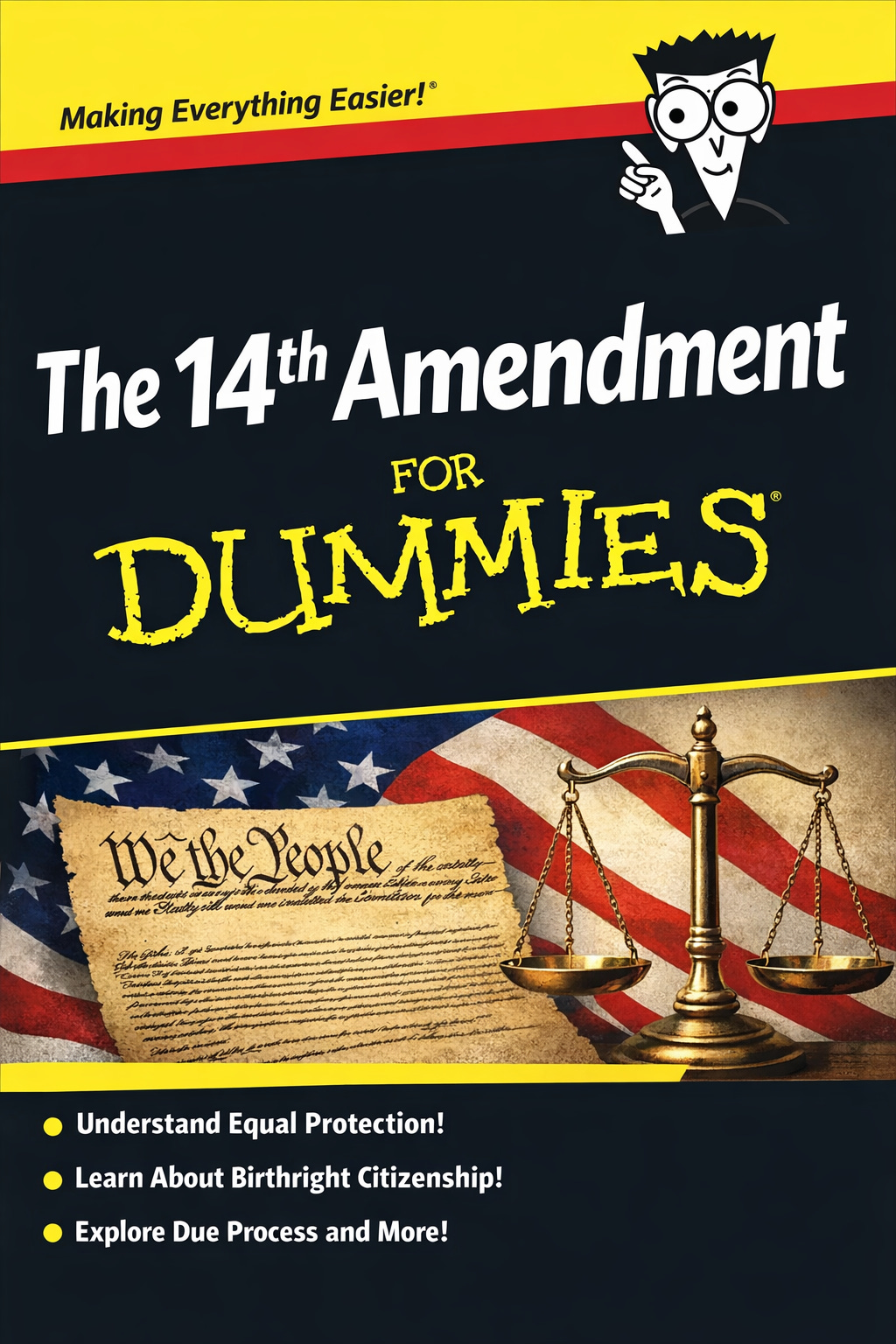
When an unconstitutional EO becomes so notorious that the Supreme Court enters the scene, The 14th Amendment for Dummies becomes required reading. My copy has just arrived. The salient FAQs are these:
1. What was the situation before the 14th Amendment? Until the 1860s, Americans had come in three colors:
Black. Since the early 17th century Black people, mostly enslaved, had been property, chattel. Their status had been confirmed as recently as 1857 when the infamous Dred Scott case gave them “no rights which the white man was bound to respect.” That decision included a slave’s infant, of course: it had been chattel from the moment of its birth.
White: since 1776 a White infant born in one of the states had been considered a citizen of that state and of the United States. When the 14th Amendment was ratified, white infants born in the U.S. had for nearly a century been assigned American nationality at birth.
Red. Historically, Native Americans had held “tribal citizenship” rather than U.S. nationality. They were – here’s that subordinate clause again – beyond the jurisdiction of the United States. At mid-19th century they were still not U.S. citizens.T
2. How did the 14th Amendment change things?
The Amendment extended birthright citizenship to Black people.
White people retained the birthright privileges that they had enjoyed since the 1770s.
Red people wouldn’t become U.S. citizens until 1924, when the Indian Citizenship Act finally declared that “all non citizen Indians born within the territorial limits of the United States [were] … citizens of the United States.”
3. So what’s with the Amendment’s “subject to the jurisdiction” clause? EO14160 claims that the clause pertains to infants born to alien mothers. Reading the historical record, though, you learn otherwise. You learn that the clause was about Native Americans, most of whom – you’ll remember – were living in the western territories under tribal, not U.S., jurisdiction. Listen to the senators as they considered the Amendment:
“It cannot be said of any Indian who belongs to a tribe that he is subject to the complete jurisdiction of the United States” – Lyman Trumbull (R‑IL), Chairman of the Judiciary Committee.
Native Americans are “subject to their own tribal governments” and are not under “full and complete jurisdiction” – Trumbull.
“The Indians are not subject to our jurisdiction in the full sense. Their allegiance is to their own tribes” – Jacob Howard (R‑MI).
“They are governed by their own laws, and not by ours, except so far as treaties or acts of Congress have subjected them” – Reverdy Johnson (D‑MD).
But what about EO14160’s claims that the clause is about alien infants born to undocumented or temporary mothers? Here is Senator Trumbull again:
“Aliens are subject to the jurisdiction of the United States.”
4. How common is the practice of birthright citizenship? Trump claims that the United States is “the only Country in the World STUPID enough to allow ‘Birthright’ Citizenship!”? He’s wrong, of course. Chile and Colombia excepted, birthright citizenship prevails throughout the Americas, from the North Pole to the Tierra del Fuego. It’s a fun fact, unchanged by Trump’s swagger: birthright citizenship is normal in half the globe.
The Pew Research Center estimates that 9 percent American newborns have undocumented mothers. The Center for Immigration Studies estimates, separately, that fewer than 2 percent of newborns are so-called “anchor babies,” infants born to foreigners who have traveled to the United States for the purpose. EO14160 isn’t about the 9 percent. Or about the 2 percent. It’s about Donald Trump’s pique, his hubris, his apparent belief that an Executive Order trumps the U.S. Constitution.
The Supreme Court is considering Trump v. Barbara this month, and most experts anticipate a decision in June.
5. What happens if Barbara wins? Not much. Birthright citizenship – which assigned American nationality to baby Donald Trump all those decades ago – will continue to assign it to all infants born on American soil. Barbara’s included. Your mother’s too, which is important because:
6. What happens if Trump wins? The first victim of Trump v. Barbara will, of course, be Barbara’s baby. Or, rather, its birth certificate, which will no longer confer the newborn’s nationality. But the next victim will be your birth certificate, which will no longer confer your nationality. Trump v. Barbara delinks birthplace from birthright, and neither your – nor come to think of it, Donald Trump’s – birth certificate will confer birthright citizenship. What, then, will verify American citizenship? You’ll think of a passport, perhaps, or a Real ID. But only one American in two has a passport, and half have no Real ID. Moreover, of course, neither document would have been issued in the absence of a born-in-American birth certificate. If Trump wins, it’ll be hard for you to prove that you’re an American. And what will we make of a sovereign state whose citizens are uncertain how to document their nationality?
So the stakes are high, and not just for Barbara’s baby. Perhaps you’ll send a copy of the 14th Amendment for Dummies to your favorite Justice. Or, perhaps, a copy of these salient FAQs will do. You’re right, of course, the Justices shouldn’t need it. As the Constitution, which they are sworn to protect, says:
All persons
born
in the United States
are
citizens….
Bruce, seems so PATENTLY obvious, why did the Supreme Court even need to hear this case? ??
Has any Solicitor General ever stated the case more clearly. A second career, Bruce?